

Something a little different this week: a consideration of a few ways to turn inputs into a set of scenarios. Probably no surprise, but I’ve written about scenarios a few times: an intro to the concept and to the 2x2 method, a quick survey of many different methods, a dive into how the choice of method affects the output, a review of SRI’s specific futures methodology including scenarios, and my own scenarios for the future of Healthcare (later published in Compass). I’ve written specifically about the archetypes of the Houston method and about narrative scenarios using classic dramatic structure. Today I want to cover a little more ground on three techniques for creating scenarios, and share what each would look like for my project, as I ponder the best way to convey the insights on my Future of Orbit project.
2x2 Scenarios
I gave this advice two years ago for picking the two drivers to use for the axes:
take the two drivers with the most impact and uncertainty3
but that footnote was doing a lot of heavy lifting:
Ideally these are independent from one another, so it’s easy to imagine one changing without affecting the other. It’s also great if the drivers are from different domains, like one technological and one environmental. Slightly trickier is the locus of control - for a small organization it makes sense for the drivers to be external, but for an industry leader or a country it might make more sense for one of the drivers to be something with a fair amount of internal influence to reflect the higher level of agency.
The latter advice makes it seem a lot harder than the simple mechanics of the former, so here’s a straightforward algorithm: take the top 4 or 5 drivers by level of uncertainty as your candidates, and develop a little what the uncertainty looks like in practical terms; if you have a clear most impactful driver in the set (which is common), then let that be one of the two, otherwise pair up drivers and test them out; pick the pair that gives you the most interesting pair of axes (likely they’ll be independent and pretty different). Or, per Ogilvy and Schwartz’s recommendations in their explanation of the GBN technique, you can just let people vote on it.
So for my Future of Orbit, here are my drivers:
A Tense Peace: Countries are developing weapons for war in space. Current equilibrium is similar to nuclear logic - proving you have the capability, but not wanting to be the first one to strike.
Junk in the Orbital Trunk: Carelessness, huge increases in the number of launches, and the threat of anti-satellite strikes are all making orbit harder to use. Options include prevention, de-orbiting, or in-space recycling and repurposing.
National Pride: Countries are competing to have competent national or regional space programs as a matter of prestige, from India to GCC countries to Africa.
Made in Space: Space is opening up brand new industries - satellite broadband and 6G but also specialized research, precision manufacturing and data centers.
The Original Satellite: After decades with minimal disturbance, the moon is now the focus of proposals for bases, manufacturing, resources, and projecting power.
Privatization Pressures: Space progress and development is increasingly driven by for-profit companies. The creative destruction of capitalism hits different in space, where “move fast and break things” can be catastrophic.
I would plot them something like this:
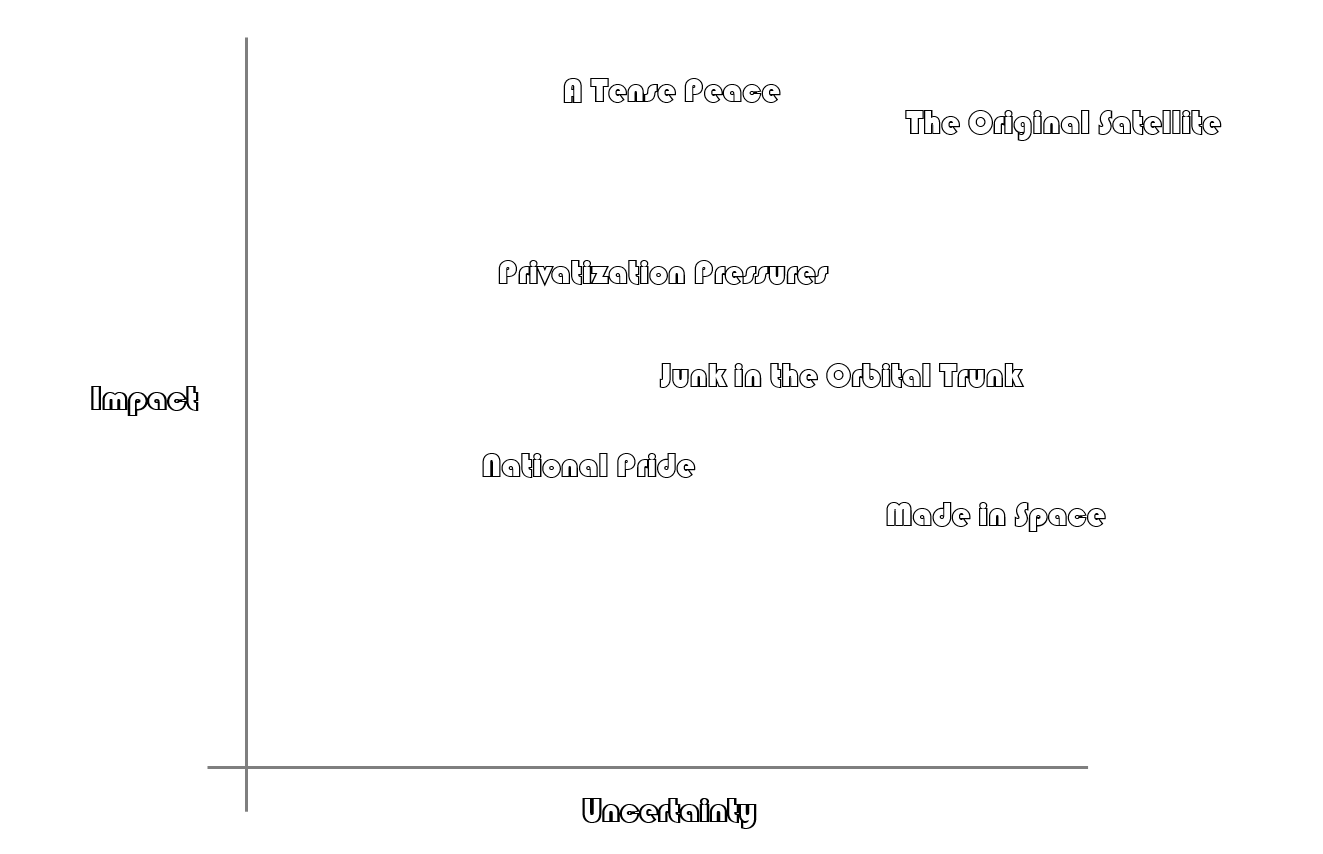
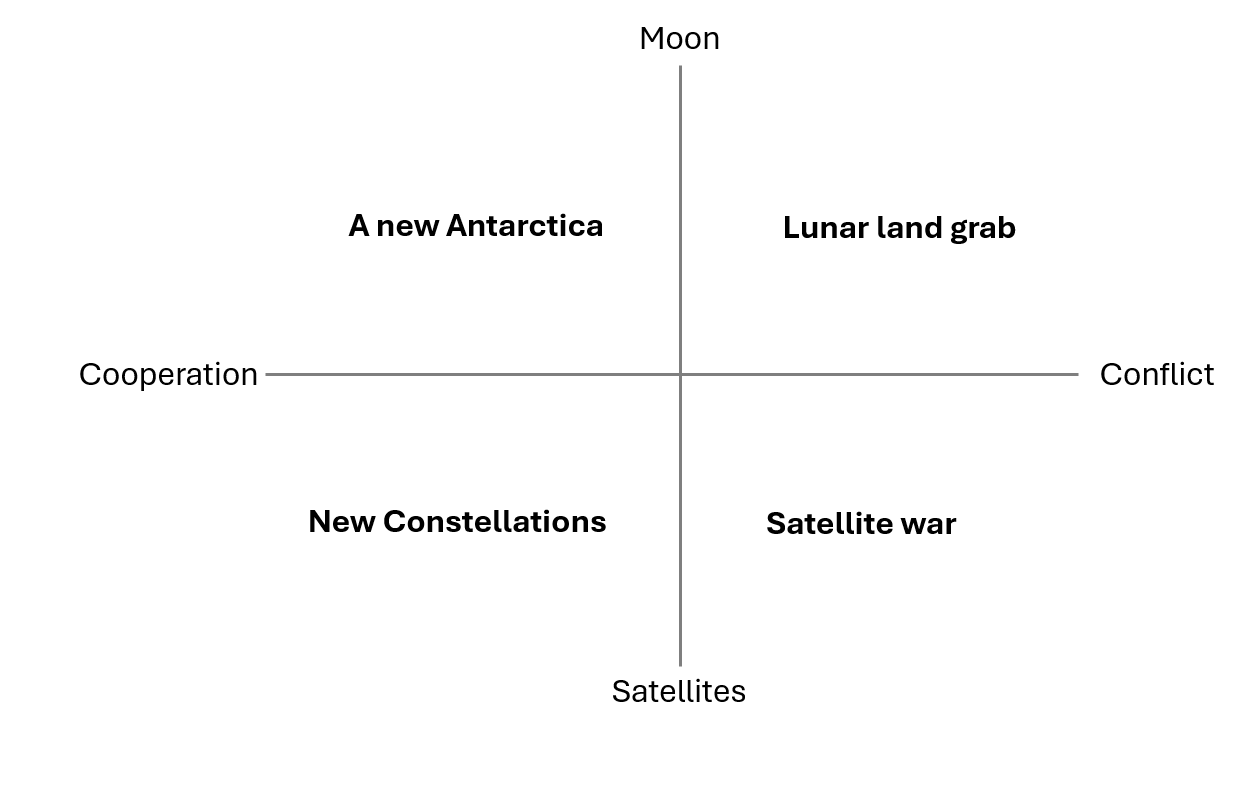
I think The Original Satellite is a great pick that should build great scenarios and has a clear pole of uncertainty: our efforts in orbit focus on the Moon, or they focus on artificial satellites. For A Tense Peace, the extremes are clear and high stakes: international cooperation vs international conflict. Privatization Pressures is clearly important but the axis isn’t immediately clear: is it government-led vs profit-led, or responsibility/regulation vs cowboy stuff, or something else? For Junk in the Orbital Trunk, the poles are definitely “dirty” vs “clean”, but that’s highly correlated with the amount of international conflict and/or corporate responsibility. Crossing the first two gives us starkly different and promising scenarios:
Let me know if you think there are better candidates for this work.
Causal Layered Analysis
I’ve written about CLA many times: as a way to write a preferred future, as a strategy to envision alternatives, as a way of understand (or enacting) social change, and how its scenarios tend to emphasis who wins and who loses. But it can be an effective framework for writing scenarios in general, because you end up writing things where you’ve ensured that the things that are happening line up with the systems and the underlying worldviews. One natural way to make this more concrete and tie this in with the pre-existing futures research is to think of the H1 scan hits as the litany of the baseline world, the drivers as the system, the current set of values (conflict between Modern and an intolerant Postmodern) as the worldview, and something like “stability” (the ruleset of the baseline archetype in Framework Foresight). Then make new sets based on different archetypal rulesets, with different values emphasis, driver outcomes, and H3 events creating a new stack. In terms of directions to take, one future set might be a Preferred (what you want), a Disowned (what you don’t want), an Integrated (a little bit of both), and an Outlier (something really surprising). The scenarios might look something like this:
Sci-Fi Prototyping
OK this one I have written very little about, though I’ve covered quite a bit of science fiction and talked about the theory of writing it at least once. Brian David Johnson wrote a whole book about this, so I won’t do it justice, but briefly the structure is to: 1) build the basics of the world you’re exploring, 2) introduce the specific change you’re looking to explore, 3) show how it changes the lives of the characters, 4) show how the characters adapt and how they respond, and 5) explore the implications. That’s it!
So in my orbit example, we’d start a few years down the baseline, where space is built up, rivalries are heated, and work is just starting on permanent moon bases. Then something happens. Possibilities:
An American satellite explodes, and Russia is blamed. Is their denial genuine or misinformation? How will the astronauts and cosmonauts on Axiom Station respond?
The autonomous facilities on the moon kick in and start replicating, then disable the manual controls. Human negotiators need to convince the AI to stand down.
A commercial space station quietly acquires the resources for self-sufficiency, then declares itself an independent micronation and threatens to seize nearby satellites as contraband. How do we de-escalate from Earth?
A solar mirror is hired by a bitter billionaire so one ex-girlfriend is always illuminated in a 50-foot circle of sunlight all night long, becoming a pariah. The courts are powerless to help because there’s no “right to darkness”. Does she lose her mind, or find her revenge?
OK those are my feeble human attempts at creativity. I afterward asked AI for other ideas and it gave me 10 that mixed drivers in various ways. They were competent, but none of them were as “fun” as these, though, except one: private recyclers get too premature in declaring satellites “abandoned” and scrapping them, and one of them has some kind of strategic MacGuffin aboard1.
Let me know which of these three approaches you think would make the best scenarios.
Scan Hit of the Week
Yeah I have to go with space mirrors this week, not even close. Not the first time I’ve heard the idea, but this is pretty far along. There’s a demo of the technology here. The initial promise is that a 60-foot mirror illuminates a 3-mile patch on Earth, making each one somewhere between 1/70,000th (my math) and 1/140,000th (NYT’s math) of the brightness of the sun, each one costing $5,000 per hour if you pre-book. The implication they will be used to run solar infrastructure at night is absolutely laughable, but disaster response at night is a cool use case. I like the note about the potential effects on plants and animals but that seems pretty far away at present.
This sounds vaguely like a lost episode of Firefly.
I vote you do the Causal Layered Analysis. The 2x2 seemed like something that I could come up with, too vanillin; the Sci-Fi ones felt too far out there. I also think the Causal Layered Analysis lets you cover more ground, a broader spectrum of ideas.